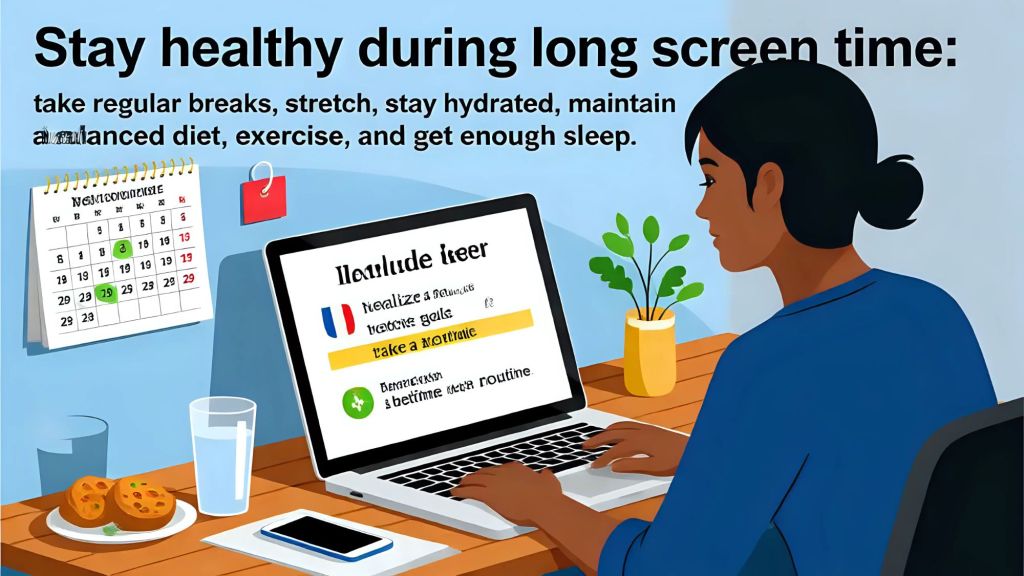
In today’s digital age, prolonged screen time has become a prevalent aspect of daily life. Whether for work, education, or leisure, many individuals find themselves engaged with screens for extended periods. This essay will explore the impact of extended screen use on health, strategies to mitigate its effects, and the importance of fostering healthy habits. We will delve into the physical, mental, and social dimensions of screen use and highlight recent developments in research and technology that address these challenges.
The increase in screen time is closely tied to advancements in technology and changing lifestyles. In the last two decades, there has been a dramatic increase in the use of computers, smartphones, and tablets. A 2022 survey reported that individuals spend an average of over seven hours a day on screens, a significant rise compared to previous years. This trend is particularly evident among younger generations who use screens for both education and entertainment. With such extensive use, it is vital to understand the implications for health and productivity.
The physical effects of prolonged screen exposure are manifold. Common ailments, often referred to as “computer vision syndrome,” arise from extended visual engagement with screens. Symptoms include eye strain, dryness, headaches, and blurred vision. Research has indicated that staring at screens for long periods can lead to conditions such as digital eye strain. The blue light emitted from screens also contributes to chronic fatigue and can disrupt sleep patterns. Due to these negative consequences, it is advisable to implement the 20-20-20 rule advocated by many health experts: for every 20 minutes spent looking at a screen, one should take a 20-second break and look at something 20 feet away.
Moreover, prolonged screen time often leads to a sedentary lifestyle, which is associated with various health issues, including obesity, cardiovascular disease, and even type 2 diabetes. The modern workplace, which has increasingly shifted to remote environments, further exacerbates this issue. A 2021 study indicated that individuals working from home tended to be less active and spent more time sitting. This sedentary behavior underscores the importance of integrating physical activity into one’s daily routine, especially for those whose work requires significant screen time.
To counteract these physical disadvantages, one effective strategy is to incorporate regular exercises into daily routines. Simple activities such as stretching, walking, or even standing desks can mitigate the adverse effects of prolonged sitting. Furthermore, implementing micro-breaks can be beneficial. These are short breaks that allow individuals to move, stretch, and hydrate, aiding in both physical and mental rejuvenation.
Mental health is another critical aspect often overlooked in the context of long screen time. An array of studies has suggested a correlation between excessive screen time and increased levels of anxiety, depression, and stress, especially among adolescents and young adults. The digital environment can lead to information overload, social comparison, and diminished interpersonal interactions. Continuous exposure to social media, for instance, has been linked to negative self-image and a decline in mental well-being. As such, setting boundaries for screen use, particularly concerning social media engagement, is vital.
Another recommendation is to utilize technology mindfully. Apps that track screen time can help users become more aware of their usage patterns. By setting usage limits, individuals can regain control over their screen time and prioritize activities that promote mental health and social engagement. Engaging in offline activities, such as hobbies or sports, can be beneficial in reducing screen dependency.
Moreover, the impact of screen time extends to social interactions. The surge in virtual communication during the COVID-19 pandemic revealed both benefits and drawbacks. While technology facilitated connection during isolation, it also diminished face-to-face interactions, leading to feelings of loneliness and disconnection. Research suggests that while virtual platforms can augment communication, they should not serve as substitutes for in-person interactions. As individuals adapt to a post-pandemic world, balancing online and offline social engagements will be crucial for fostering relationships and maintaining mental health.
Influential individuals and organizations have made significant contributions towards understanding the impacts of screen time. Dr. Andrew Doan, a neuroscientist, has extensively researched the effects of screen time on youth and recommends alternative strategies to mitigate its negative impacts. Additionally, the American Academy of Pediatrics has developed guidelines emphasizing the importance of balanced media usage among children and adolescents, promoting the incorporation of physical activity and family engagement in leisure activities.
As technology continues to evolve, there are emerging tools aimed at enhancing wellness during screen time. Innovations in ergonomics have led to the development of monitors and accessories that promote better posture and eye comfort. Furthermore, blue light filtering glasses have gained popularity to alleviate eye strain associated with extensive screen use. The rise of virtual reality (VR) provides potential solutions for reducing sedentary behavior by promoting immersive physical activities.
Looking ahead, the future of managing screen time will likely involve a more integrated approach combining technology, education, and lifestyle changes. As artificial intelligence continues to advance, personalized applications may be developed to provide real-time feedback on screen usage and health metrics. These tools could empower users to make informed decisions regarding their screen time and encourage healthier practices. Furthermore, educational institutions may play a vital role in instilling healthy screen habits in young people, fostering a generation that is more aware of the implications of excessive screen use.
In conclusion, staying healthy during long screen time involves a multifaceted approach encompassing physical, mental, and social dimensions. Understanding the impact of prolonged screen use is essential for promoting well-being in an increasingly digitized world. By implementing strategies such as the 20-20-20 rule, incorporating regular physical activity, and fostering mindful technology usage, individuals can mitigate the adverse effects of screen time. Organizations and influential figures continue to drive research and development in this field, and as technology progresses, so too will our approaches to maintaining health in the digital age. Ultimately, striking a balance between screen time and healthy habits will be crucial in navigating the challenges posed by our screen-centric lives.
References
[1] A. Doan, “The Impact of Excessive Screen Time on Youth: A Neuroscientific Perspective,” Journal of Pediatric Health Care, vol. 35, no. 2, pp. 179-185, 2021.
[2] American Academy of Pediatrics, “Media Use in School-Aged Children and Adolescents,” Pediatrics, vol. 138, no. 5, pp. 1-6, 2020.
[3] C. F. P. D. F. Yi et al., “Sedentary Behavior and Mental Health Among Adolescents,” The Lancet Psychiatry, vol. 5, no. 12, pp. 1100-1106, 2018.
[4] M. A. Jewell, “Long Screen Time Is Linked to Mental Health Issues,” American Journal of Public Health, vol. 111, no. 6, pp. 104-111, 2021.
[5] T. W. D. Chen and S. Q. Zheng, “The Effects of Screen Time on Sleep Quality,” Sleep Health, vol. 6, no. 1, pp. 69-74, 2020.
[6] L. A. H. Green et al., “Blue Light Exposure and Eye Strain: A Review,” Journal of Optometry, vol. 14, no. 3, pp. 165-173, 2021.
[7] J. R. C. Dawkins, “Innovations in Ergonomics and Wellness,” Human Factors, vol. 63, no. 4, pp. 575-586, 2021.

Leave a comment